

“Sustainable Income for Women: Scalable Solutions for Economic”
Low-Income Families Need Sustainable Solutions Across many communities,
low household income is no longer a temporary challenge. it is a daily reality that affects education, health, and long-term stability. According to the World Bank, women remain overrepresented in informal work, with limited access to stable income and social protection.
In addition, the International Labor Organization reports that women’s global labor force participation still lags behind men, despite clear evidence that economic inclusion can significantly boost national growth. Women Drive Household Resilience Today, women play a critical role in sustaining families. Many manage households while also generating income. In many cases, they serve as primary providers for children and extended family members. However, although motivation is high, access to practical training and real market opportunities remains limited.
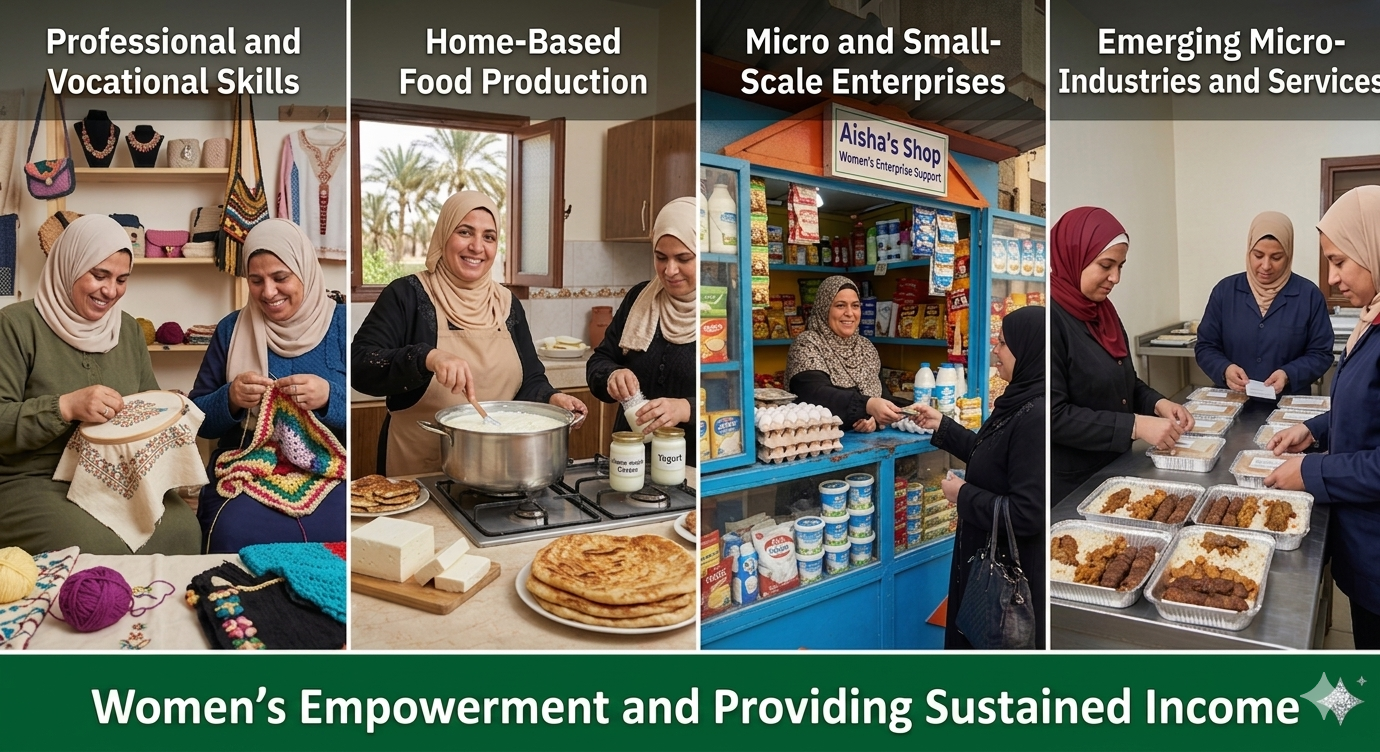
Our Practical Training Pathways Therefore, our foundation delivers hands-on, market-driven training programs that transform skills into sustainable income. We design these pathways to match real local demand and maximize employability:
⚫ Vocational and craft-based skills: tailoring, embroidery, crochet, handmade products, and accessories production.
⚫ Home-based food production: dairy processing such as cheese, yogurt, and butter; baked goods; traditional and rural food products with strong market demand.
⚫ Micro and small enterprises: mini-markets, grocery shops, kiosks, home-based retail, and local distribution models. – Service-based income opportunities: home nurseries, catering, cleaning services, and meal preparation businesses.
⚫ Emerging micro-industries: packaging, light food processing, and resale models integrated into local supply chains. Moreover, each program goes beyond technical training. We equip women with essential business skills, including pricing, basic financial management, and market positioning.
As a result, participants build income streams that are both independent and sustainable.
Why Us
We combine field expertise with practical execution. Our team brings years of hands-on experience in vocational training, community development, and women’s economic empowerment. Moreover, we prioritize real-world application. We deliver workshop-based training that reflects actual market conditions, ensuring that participants gain relevant and income-generating skills. In addition, we provide structured follow-up and mentorship. This ongoing support helps women stay on track, improve productivity, and navigate early-stage business challenges.
As a result, we do not only train—we enable measurable economic outcomes.
Our 2026 Vision By 2026,
we aim to reach more than 700 women in underserved communities and equip them with practical, income-generating skills that lead to financial independence.
Call for Strategic Partnerships
We are actively seeking funding partners and international organizations to scale this proven model. Your investment will directly enable the delivery of training programs, post-training support, and the creation of sustainable income opportunities for women.
With your support, we can expand our reach, strengthen local economies, and create measurable, long-term impact. Together, we can transform skills into livelihoods—and opportunity into lasting economic empowerment